By A.J. Kaufman, Managing Editor
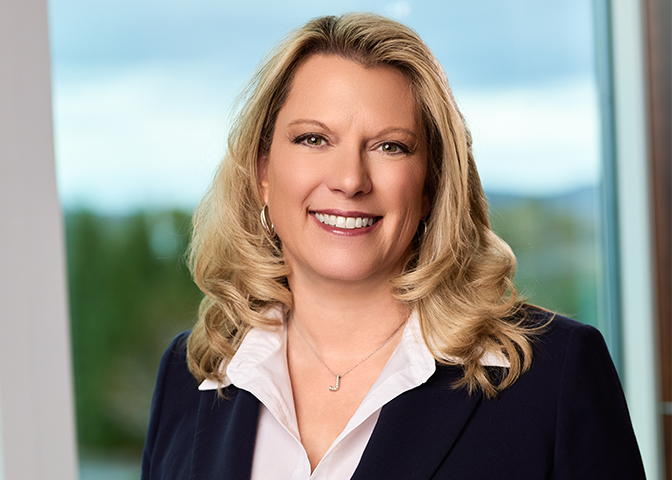
Earlier this summer, when the BRIDGE regional economic development organization celebrated a major victory, Julie Bennett, as their board chair, was front and center. In a moment of progress for the region, Breeze Airways announced new nonstop service from Tri-Cities Airport to Orlando and Washington D.C. starting in December. Bennett called it “a transformational moment for our region” and “the result of strong collaboration and a shared vision for growth.” Indeed, BRIDGE played a key role in making this service possible by bringing together public and private partners to invest on behalf of communities across Northeast Tennessee and Southwest Virginia.
A native of the region, Bennett grew up in Sullivan County and earned her undergraduate degree at Auburn University and a law degree from Mercer University School. She currently is Executive Vice President/Chief Legal and Governance Officer, Corporate Secretary and Chief of Staff to the CEO for Ballad Health. Prior, she was vice President and General Counsel for Bristol Motor Speedway and a partner with Hunter, Smith and Davis law firm.
The Business Journal recently reached out to Bennett to learn more about her work experiences and thoughts on current economic development across our region.
Business Journal: Why did you pick the law as your career, and was being in your current role (or any roles you’ve held) an original goal of yours?
Julie Bennett: My parents were fond of saying that I would argue with a fencepost. I was focused on corporate law from at least my junior year of high school and made many choices with that focus in mind. While I had never viewed myself as a litigator, I spent much of my career at Hunter, Smith and Davis doing at least some litigation, which was really great experience and equipped me to better work in my later roles. In college, I became interested in employment law and carried that interest through law school. One of the things I loved most about that practice area was that it exposed me to many aspects of the companies I represented, and I worked with many interesting people as I grew my knowledge of business. This expanded as I worked at Bristol Motor Speedway. The full-time staff is a small group, and my role crossed over every part of the business operations. While I can certainly say that I had no specific vision to work in the particular corporate jobs I have held, these types of roles have always been the kinds of jobs I have found appealing.
BJ: Speaking of original goals, once you began in the current role at Ballad, what were some priorities and, since then, accomplishments worth noting?
JB: While there is no simple, bullet-point list of priorities I can point to, I would say that one of the things I have been most excited about and fulfilled by is the team I work with every day. I want to do what I can to build strong legal, government relations and strategic communications teams, while supporting the CEO and the entire executive team. Health care is a very complex industry, and I have learned a tremendous amount in the short time I have been with Ballad Health. My goal is to build great relationships and tell our story effectively both inside and outside the organization. I am constantly impressed by the caring and compassion of the leaders in our organization and the individuals who provide exceptional care to our patients. Every decision that is made and every action that is taken is done with the best interest of our team members, patients and communities in mind.
I genuinely desire to find ways to highlight the amazing work of our team members and demonstrate to our patients and the community just how good we are at what we do. We are one of the region’s largest employers, and we take that responsibility very seriously. Our team members show up in the communities they serve as volunteers, non-profit board members, and solid citizens. We have some of the best people in our region working at Ballad Health and I want our community members to see the positive impact we have on the overall health and well-being of the people who live and work in our service area.
Something I continue to reflect on as a poignant moment in my time with Ballad Health was seeing our team respond during the unexpected events caused by Hurricane Helene. Not only did we witness heroic acts by both team members and civilians who were evacuated safely from the rooftop of Unicoi County Hospital, but for months to follow, we heard stories of our team members volunteering time to clean up homes in Damascus, Va., transport water to Johnson County, Tenn., and organize blood drives in Greeneville, Tenn., to honor the life of our fallen team member, who perished while attempting to save a life during the flood.
BJ: What advice do you give to women, or anyone, considering starting their careers in the corporate world — either here in Appalachia or elsewhere?
JB: For anyone starting a career in the corporate world, I would recommend learning everything you can—not only about the company you are working for, but also the industry you are working in. Staying current on issues affecting the business is important to your growth as a professional. It is easy to get caught up in a narrow focus area of a business because that’s what you’re working on every day, but if you understand the bigger picture of where the industry is heading, you are better positioned to be a valuable asset to the business, which leads to new opportunities.
On a personal level, it is important to be authentic. Understand that you are absolutely perfect at being you, and that you will exhaust yourself trying to be someone else. Find what gives you joy and use your God-given gifts to their greatest advantage. I believe it is also important to keep your word and do the work to the best of your ability. Don’t cut corners. People can always tell.
Look for ways to build others up. This is especially true for women. While the corporate arena has certainly shifted for the better, I still see many instances where women feel competitive with other women and don’t support their growth—or worse, take credit for the work of others or put them down to make themselves look better. There is room for many women at the table, and we should be supporting and celebrating other women when they are successful. Find someone who is interested in your success and seek their advice and counsel. At the same time, avoid unhealthy relationships.
BJ: As far as late July’s big announcement is concerned, tell me more about why you joined the BRIDGE Board, and what these new flights will mean for the community/region?
JB: I am honored to serve as chair of the BRIDGE board of directors. I have been interested and engaged with BRIDGE since it was founded. Having grown up here and having been involved in the business community for over three decades, I have come to believe that we are limiting ourselves when we focus on city, county and state lines instead of how much better we can be when we work together on regional opportunities.
The air service announcement is a perfect example of how great we can be when the public entities and private businesses in the area partner together for something that is good for the entire region. BRIDGE is a privately funded regional economic development organization that partners with regional communities and private partners. Its objective is to identify those regional priorities that can benefit the entire region without letting boundary lines limit the vision of the future. It is exciting for me to see what we can accomplish by working together.
These new flights will offer greater convenience for travelers into and out of the Tri- Cities Regional Airport by increasing the number of domestic and international connections available and providing easier access to major markets in the eastern United States and abroad. New flights will support tourism and create new jobs at the airport and across the region. One of the most exciting things about the addition of a new carrier and new flights is that the addition of a new air service partner can create a snowball effect. When one airline decides a market is a good place to locate a new route, other airlines often follow suit. We are not only hopeful that this will be the case here; we are establishing an Air Service Committee with communities represented on the Airport Authority that will ensure alignment with regional economic development goals and help us prepare for and proactively seek new opportunities to continue to grow air service.