By A.J. Kaufman, Managing Editor
King University, the only four-year liberal arts college within Bristol, is proud to be growing. Amid some dwindling campus enrollments nationally, King witnessed a sizable uptick in enrollment with this fall’s incoming class.
King’s overall enrollment for the fall 2025 semester showed a 7% growth between online and traditional/on-campus students. They had a 20% increase in traditional students and an 18% increase in residential hall occupancy. The school’s total institutional enrollment for undergraduates currently sits at just over 1,200 students.
How did this achievement happen, and what’s being implemented recently to encourage the uptick?
Earlier this autumn, the Business Journal spoke to Ashley Hartless, Associate Vice President for Enrollment Management at King, and Matt Roberts, Provost and Vice President for Academic Affairs.
“We’ve been trying to focus on developing our student success initiatives internally,” Hartless said. “We have our retention council, focusing on students and their experience and faculty and staff initiatives, where if you see students who are struggling or not participating actively early on, make sure they are getting the attention they need from their advisors and faculty.”
They have also created new scholarship opportunities for students, including a successful “scholarship summit” last December and another this year.
“We are breaking through the idea that private Christian education is exclusive or elite and unattainable for their means,” Roberts explained. “The truth is that, with students graduating from King, their average student loan debt is very similar to other schools in the area.”
Roberts noted that President Andrew Tooley, who began leading King in August 2024, has extensive fundraising experience. He says the scholarships are “not unfunded mandates,” and many of them are supported by donors who seek to boost King’s enrollment.
Roberts told the Business Journal that a new initiative is specific Bristol-area high school-based scholarships, starting in Fall 2026. That includes Tennessee High School, Virginia High School, John Battle High School and Sullivan East High School, with goals to expand further.
“We’ve had good receptiveness to that, like any time you talk about the ability to help students,” Roberts added. “President Tooley is very community oriented, integrating the college more so into the community and just being a good neighbor.”
Hartless says King has focused on marketing strategies and methods to reach students on platforms they use, including social media, as well as text and email.
“Being able to see the landscape of our area draws them to the area from far out. This has helped students through the application process,” she explained. “We’ve been able to take them from their campus visit experience …and enhancing that, from their prospect stage all the way through enrollment, to be the simplest and smoothest process possible.”
King has a geographically diverse student body, although the majority of this freshman class are Tennesseans, with the second most common state being Virginia.
With four-year college enrollment declining gradually over the last decade, especially among young men pursuing work over school and debt, King believes it can overcome any long-term numerical concerns.
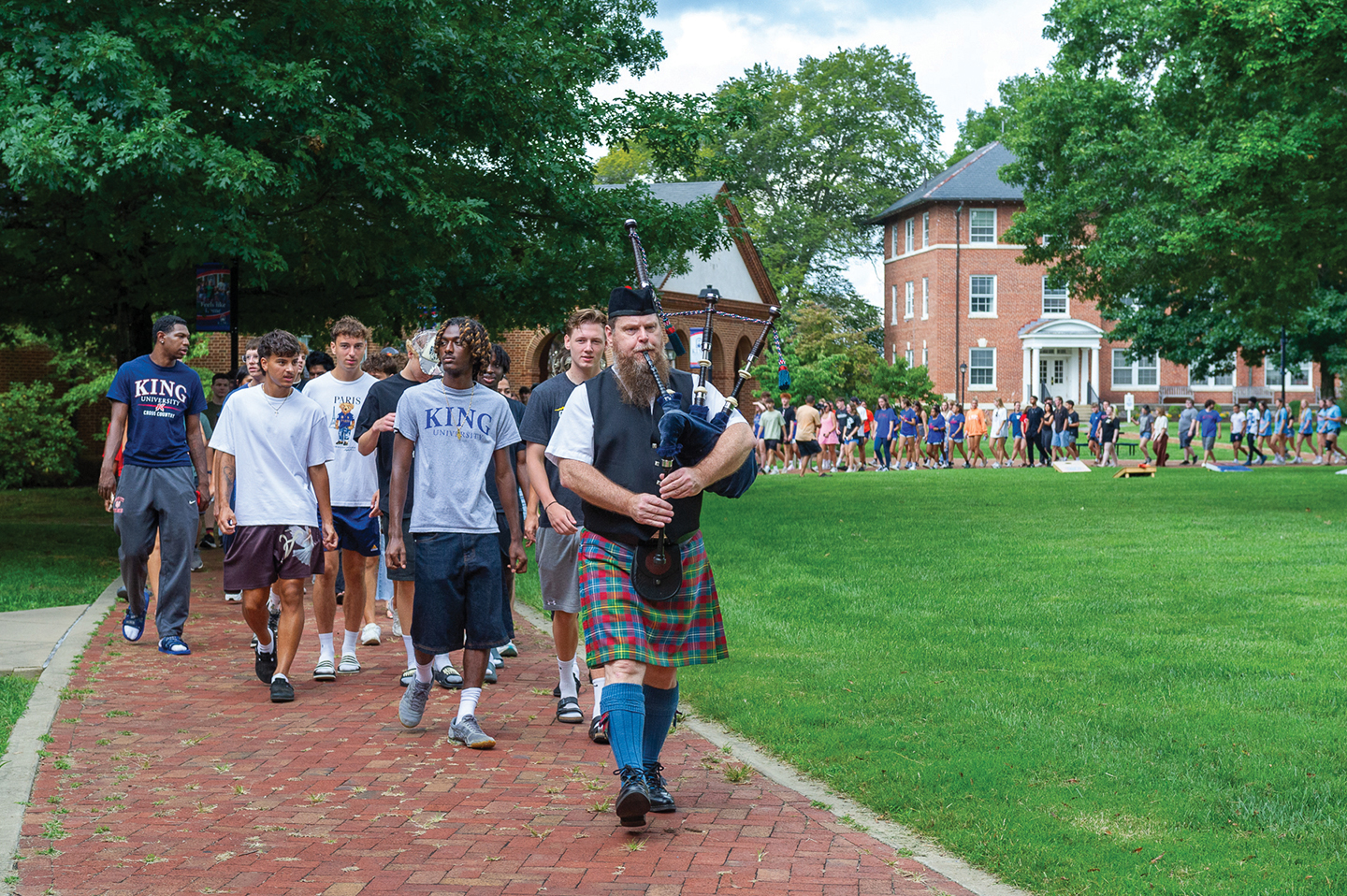
“We want to be proactive. We read the literature, and all hear about the demographic cliff…,” Roberts noted. “It concentrates the mind to get out there to carry through on the momentum. We are blessed to see that increase because we are acutely aware that is not the case at every institution. But I also think what we are seeing is there is a hunger for families to find a Christian liberal arts institution. And the beautiful thing for King is that we are historically a liberal arts institution, but we’ve been blessed to see success in many professional programs.”
Roberts cited the business, education and nursing programs.
Hartless noted that for students who choose to enter the workforce or community college out of high school over King, the university has online programs and partners with area community colleges.
“Some students choose a different path after high school instead of going to the traditional four-year route,” she explained. “King offers opportunities for those who spend time in the workforce and later need a bachelor’s degree to take the next step in their career.”
She added that King has various articulation agreements with Virginia Highlands Community College, Northeast State Community College, Walters State Community College, Mountain Empire Community College and Southwest Virginia Community College, especially the Bachelor of Science in Nursing degree in 12 months.
“We are working with our partner schools to develop programming that meets the workforce needs,” Hartless explained.
Roberts says he believes almost all students in the RN to BSN cohort online programs are working full-time as nurses.
“We have to meet the demands of the workforce while students also balance job and family requirements,” he added.
Other popular fields, especially for transfers, include business, accounting, criminal justice, cybersecurity and cloud computing. Hartless shared that articulation agreements have been or are being developed for a lot of those.
On the horizon, King is in the beginning phases of developing a center for entrepreneurship to serve this unique region.
“We want to be a vehicle to help with economic stimulus, particularly when we talk about rural entrepreneurship,” Roberts shared.
They are developing an advisory council and seeking business leaders interested in joining the effort.
All programs within the School of Business, Economics, and Technology will soon require an internship.
“That is designed to connect students with high-growth employment sectors and support local economic development but also introduce them to the working world and help them gain more insight on the job,” Hartless said. “They are not exposed to everything from the classroom or from observations and having that actual touchpoint and responsibilities of an internship will be critical for these students. And so, the School of Business is taking that very seriously and wanted to implement that for all of their students.”
King leadership says the school can be a vehicle to bring the best talent from across the nation to the Tri-Cities while still ensuring Tennesseans and Virginians remain in the Appalachian Highlands.
“We find that many students who come from very far places fall in love with the region and start their career here,” Roberts concluded. “There is a lot of strong local talent. It is very important that we recognize, identify, and retain that strong local talent, while also attracting an influx of talent. Our workforce and region benefit from the best the two have to offer, and universities like King play an important role where these two talents often meet. King’s commitment is to be more strategic, intentional, and collaborative in this space.”