By A.J. Kaufman, Managing Editor
The Business Journal of Tri-Cities recently sat down with long-time regional data and market analyst Don Fenley to gather his insights into current and future market conditions.
Business Journal: Share your background and how you got started, particularly in market analysis and journalism.
Don Fenley: I started in journalism in high school with my hometown newspaper and English lit classes. During my time in the U.S. Army, I did some part-time work with the military newspaper even though journalism wasn’t my primary job. During the five decades after my military service, I worked at the Dallas Times-Herald, Santa Fe New Mexican, Yakima Herald-Republic, Orange Coast Pilot, USA Today, Manassas Journal Messenger and Kingsport Times-News.
In all that accounts for a little over 50 years in print journalism. After the layoffs at the Times-News, I launched a second retirement career in more detailed and deeper research with CoreData and as a consultant on localized reports focused on the labor market, housing, economic and demographics.
BJ: Describe what you enjoy most about researching and analyzing market trends.
DF: I began moving past the surface level on localized economic research and analysis while working in California in the late 1980s. It became more focused during my time in the Washington, D.C. market, where it helped me receive the National Press Club’s award for distinguished local editorial writing. My interest sharpened at the Times-News when I began tracking things like the local birth-death rate imbalance and aging trends, shifts in consumer trends via the distribution of local sales taxes, transformation of the regional economy from a manufacturing to a health care and education base, and eventually the social and economic impact of the regional housing market. What I enjoy most about the research and analysis is that data and long-term analysis not only help explain in detail what has happened, it provides a better base for an understanding of the what and why of current conditions. In some cases, it can also be predictive. In-depth, quality local market research and data is critical but is not part of most general media’s offering.
BJ: Offer an overview of the current residential and commercial real estate market in the region.
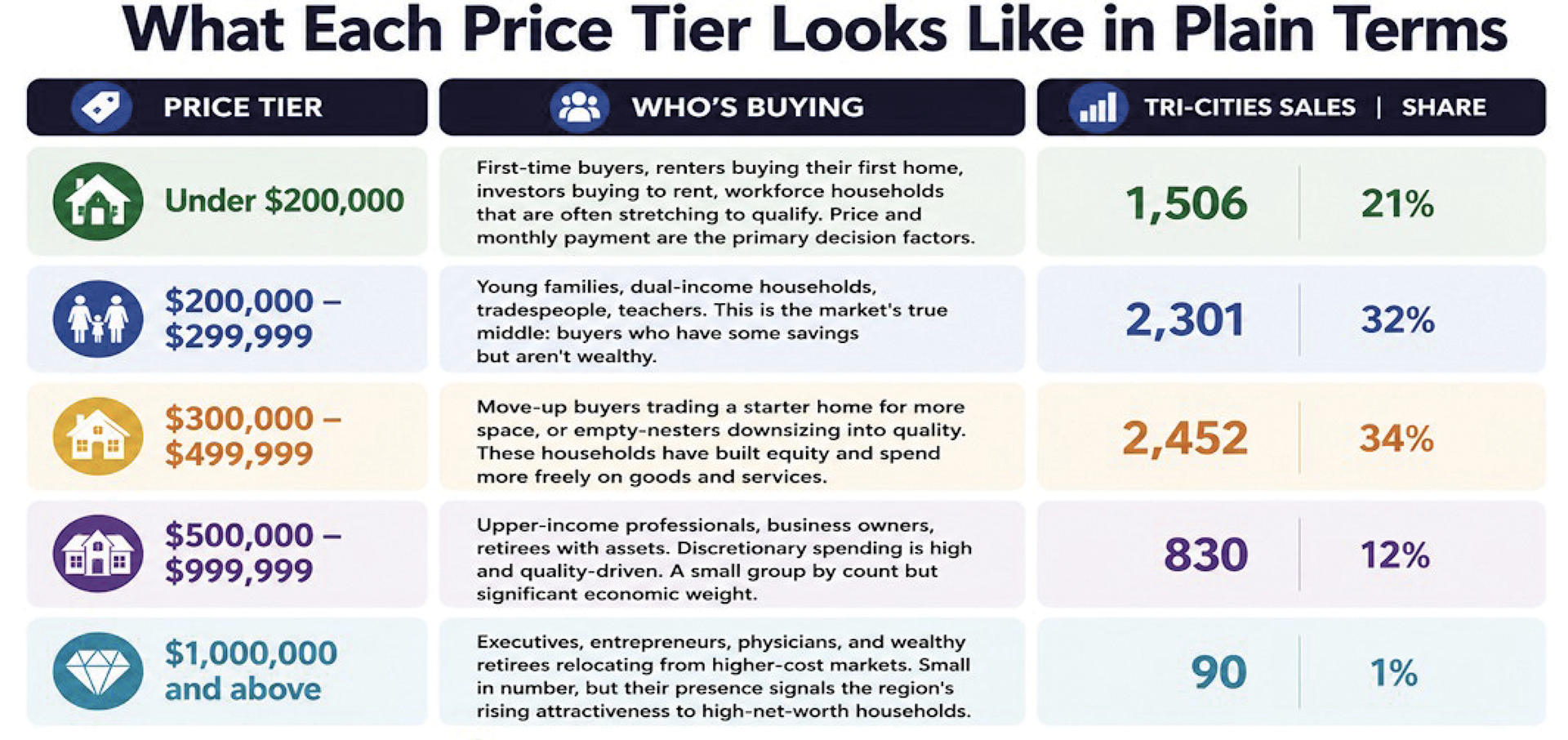
DF: The Tri-Cities is a stable and rebalancing market where the growth rate has consistently outperformed the national and many Tennessee housing markets for about eight years. It is currently the most affordable metro market in East Tennessee, characterized by tight inventory that is slowly improving after a couple of decades of underbuilding. Although the market is still very much the seller’s market, balance is slowly returning. The biggest challenge is affordability. The most current data from the Atlanta Federal Reserve Bank’s Homeownership Affordability Tracker shows affordability improvement in every local county except Washington (TN) and Unicoi, where owners are spending 43% of their gross income on housing. That places those owners in a housing stress status.
The commercial market is maturing and healthy overall. Inventory is low, and despite demand lagging national levels, rents have increased faster than the national pace in both metro areas in all sectors with one exception. Office demand in Kingsport-Bristol is stronger than it is nationwide, according to an analysis of data from the Census, Bureau of Labor Statistics, Bureau of Economic Analysis and CoStar by the National Association of Realtors Research Dept. and CoreData.
BJ: Discuss housing challenges facing the Tri-Cities and broader Appalachian Highlands.
DF: Housing has strong demand, hampered by a slower than normal participation of existing owners in the market inventory flow, combined with the slow creation of new housing inventory. This has placed increasing pressure on construction costs, materials, labor, and ultimately the delivered price to homeowners and renters. Participation by locals is a product of owners resistant to giving up low mortgage rates, affordability pressures driven by average mortgage payments that have increased at or above 100% from their pre-pandemic level, while wages have increased 25%, and the accelerated pace of an aging population.
Residential development neighborhoods are largely clustered within existing municipal sewer service networks. Cities are capturing much of the residential growth because of sewer availability. While privately-owned utility districts using low-pressure sewer systems are becoming a more common way to address these infrastructure constraints, the trend has not yet meaningfully entered the Tri-Cities region, but it may become an important future consideration if the region intends to continue supporting residential growth.
Commercially, development is largely driven by business operators and outside investors who study the region’s economics in search of opportunities. A recent analysis shows most new commercial development locations are not being built on undeveloped greenfield sites because very few such sites remain along prime corridors. Most developments have been made by demolishing existing buildings and replacing them with new buildings for commercial use.
The industrial real estate sector has suffered the most from the region’s lack of new inventory. A development study by TCI Group, based on public property appraiser building records dating back to the early 1900s, shows very little new industrial building construction has occurred over the past 10 years.
The demand for small industrial buildings has not disappeared. What has changed is the region’s ability to deliver industrial sites and buildings for small businesses. Most new industrial parks and industrial buildings are funded with government incentives or support. These incentives are often directed toward larger industrial recruitment efforts. However, similar support is generally not available to small business owners or private developers seeking to create small business parks or flexible industrial spaces.
BJ: Anything on the horizon we should watch?
DF: The availability of potable water outside areas with existing infrastructure. The region’s geology combined with development has and is endangering well water quality. There’s also increasing complaints that the stress on existing infrastructure is causing issues like low water pressure.