By A. J. Kaufman, Managing Editor
The University of Virginia’s College at Wise hosted its 11th annual Southwest Virginia Economic Forum just before Memorial Day.
The theme for the gathering of more than 350 business leaders, innovators and community members from across the region was “Rooted & Rising,” which explored how Southwest Virginia and the broader Appalachian Highlands can honor its community foundations while advancing forward-looking economic growth.
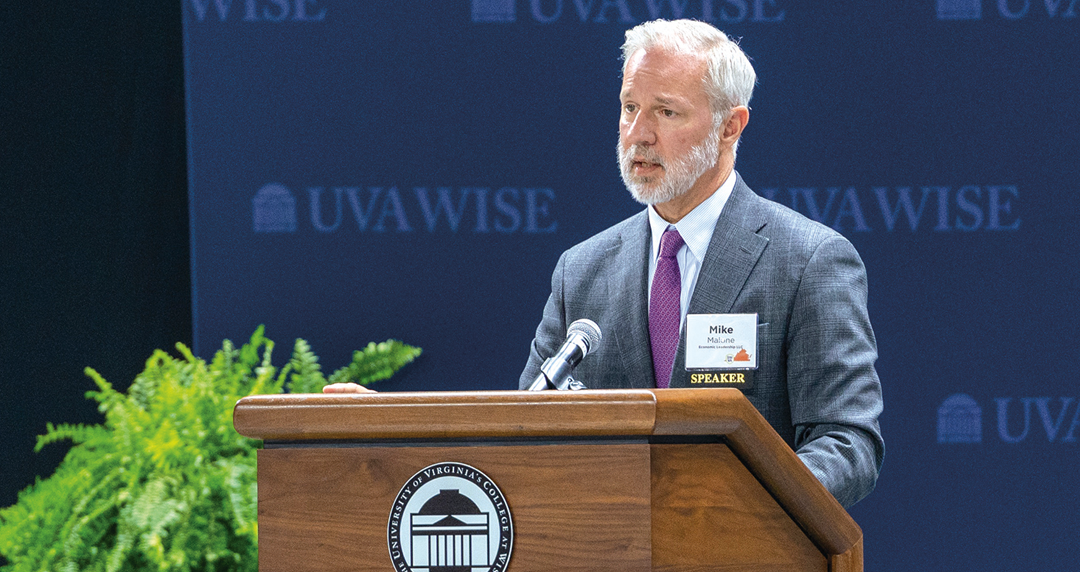
Held inside the spacious David J. Prior Convocation Center, the agenda featured a lineup of prominent speakers, including Virginia Secretary of Commerce and Trade Carrie Chenery and Rita McClenny, president and CEO, Virginia Tourism Corporation. Amanda Weinstein, director of research at the Center on Rural Innovation, spoke about the challenges and opportunities rural communities like Southwest Virginia face; while Mike Malone, a partner with North Carolina-based Economic Leadership LLC, spoke about the AI landscape — balancing its opportunities with impacts — to close the afternoon.
UVA-Wise Chancellor Donna Henry — interviewed in the May Business Journal of Tri-Cities — opened and closed the day by emphasizing the importance of the conference and bridging the gap between students and the economy.
“The continued momentum behind community and economic development efforts in Southwest Virginia is encouraging,” she said at one point.
Virginia Gov. Abigail Spanberger made her first appearance in Wise to deliver a keynote speech. After Del. Terry Kilgore introduced her, the governor applauded the region’s resilience and its strategic part of the future. Much of her 10-minute speech focused on offering stability, predictability and reliability.
During media availability afterwards, considering her predecessor — former Virginia Gov. Glenn Youngkin — visited Southwest Virginia more than three dozen times, the Business Journal of Tri-Cities asked the governor if we can expect to see more of her and what kind of economic development and business-related endeavors the region might look forward to during her term.
“You can absolutely expect to see more of me,” she replied. “Related to overall economic development is the steadiness of cohesiveness. And certainly, there’s a lot of cohesion, but from the perspective of the readiness of public safety side, we went through practice scenarios of different types of larger-scale emergencies and what are the holes that, frankly, from a state perspective, we need to be aware of and where can we help ensure that there is state and local or regional partnership when it’s necessary.”
She added in her speech that Southwest Virginia has deep roots, community, culture, hard work and resilience.
“It is a region that is actively rising, forging new economic opportunities for the next generation,” the governor claimed. “Persistence says a great deal about the character of Southwest Virginia, and it is one of the region’s great strengths…Southwest Virginia has earned its place in the history of our Commonwealth. But it is not simply an important part of Virginia’s past; Southwest Virginia is a strategic part of Virginia’s future.”
Spanberger recapped economic progress and investment, along with her administration’s three priorities for economic growth. She noted that 18 projects creating roughly 1,500 jobs have been secured for the region in the last five years with the state’s assistance. The governor said tourism and cultural heritage are regional growth success stories, sustaining nearly 12,000 tourism jobs.
“One is to supercharge Virginia’s business growth; two, to build an economy that delivers for every Virginian—not just the populations centered in Northern Virginia, Richmond and Hampton Roads; and three, to prepare Virginians to lead the industries, technologies and workforce transitions that are shaping the economy of the future,” she explained. “We all know there is no one-size-fits-all solution coming out of Richmond, and we are focused on supporting this region in ways that help our own vision of the future.”
The new governor additionally noted that economic development does not happen in silos.
“Housing, childcare, infrastructure, workforce, tourism, entrepreneurship, energy and affordability all shape whether communities can compete and grow,” Spanberger concluded.