By A.J. Kaufman, Managing Editor
Many tipped workers will see noticeable changes to their taxes after Congress approved President Donald Trump’s One Big Beautiful Bill Act in July, which created a temporary tax exemption for tips.
Once the provision goes into effect, workers will be able to deduct $25,000 in tips annually from their taxable income. After that, tips will be federally taxed.
The deduction phases out for individuals earning more than $150,000 and couples earning over $300,000. It applies to tax years 2025 through 2028 and does not eliminate payroll taxes for Social Security and Medicare, nor will it affect state or local taxes.
Brian Crutchfield, a tax supervisor at Blackburn, Childers, & Steagall, offered some guidance to taxpayers seeking to comply with the new law.
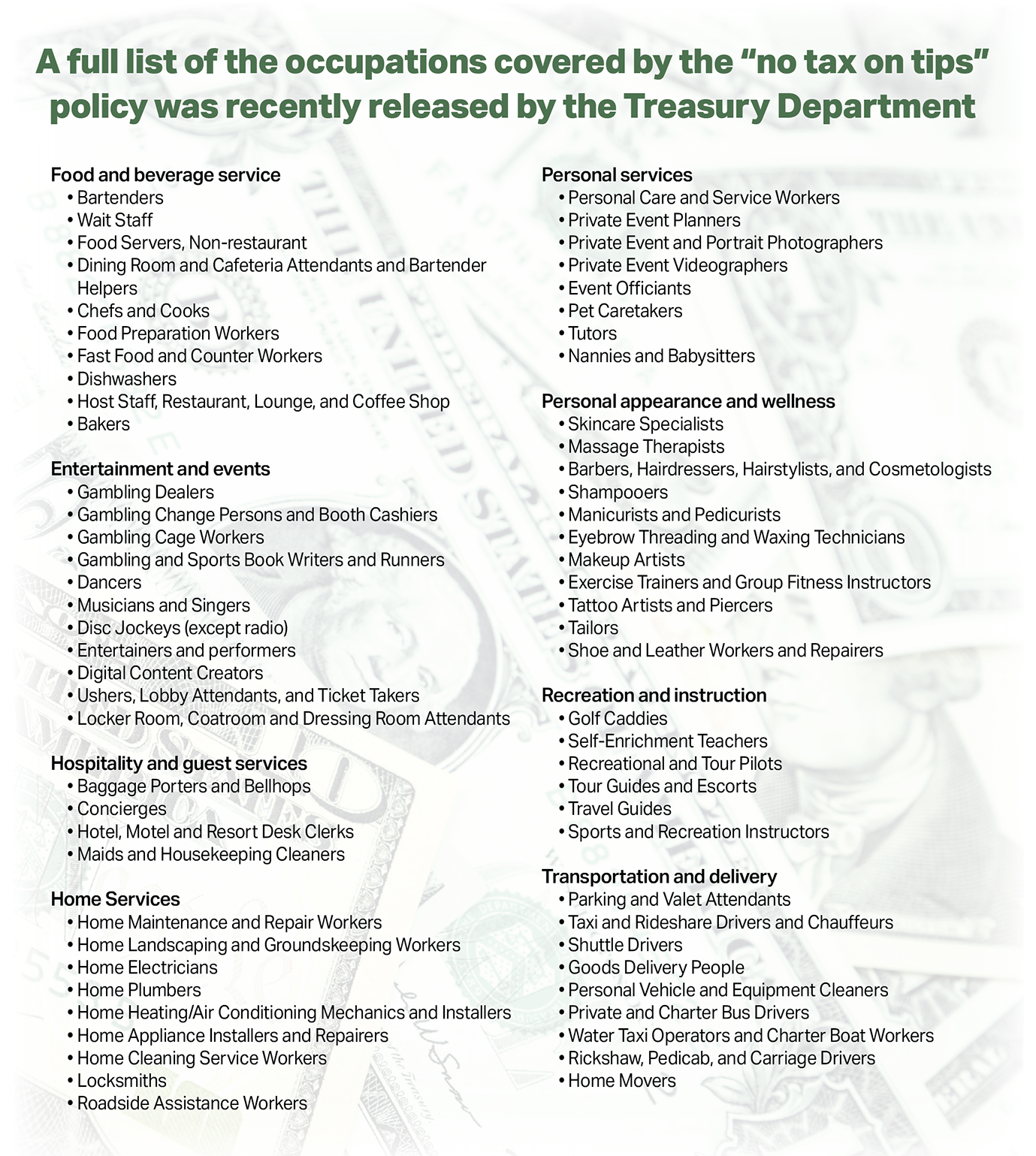
“Individuals should confirm that their occupation is included on the Treasury’s published list of jobs that “customarily and regularly” receive tips,” he told the Business Journal. “Additionally, married couples should be aware that they must file jointly in order to claim the deduction. Finally, for those who are eligible — particularly self-employed individuals — it is advisable to maintain thorough records of all cash tips received, since standardized employer/payor reporting requirements will not take effect until 2026.”
Other views on the policy vary, often by political leaning.
“What we don’t want is people to game the system. We want it to be hardworking Americans who depend on tips,” Treasury Secretary Scott Bessent recently said while visiting Virginia. “Their first $25,000 is tax-free, and that’s going to cover a huge number of American workers.”
Others have called it a win for people who live off tips, as it is real money back into the pockets of nearly 2 million restaurant servers. When that money — essentially an overnight raise — gets spent, it helps the economy.
However, the Center for American Progress, a left-leaning think tank, wrote, “the deductions for working people, including for tips and overtime pay, are not well-designed to benefit people most in need and are subject to strict limits.”
As often is the case, I am mixed on the measure.
While I appreciate putting more money into the hands of hard-working people, this began as a promise on the campaign trail last year in Nevada by Trump. It has the aforementioned stipulations and is temporary. Further, who has enough income to fully benefit? Many tipped Americans earn too little to owe federal income tax in the first place. Between the standard deduction and other credits, a large share of tipped workers already have zero income tax liability. For them, the deduction quickly becomes a mirage.