By A.J. Kaufman, Managing Editor
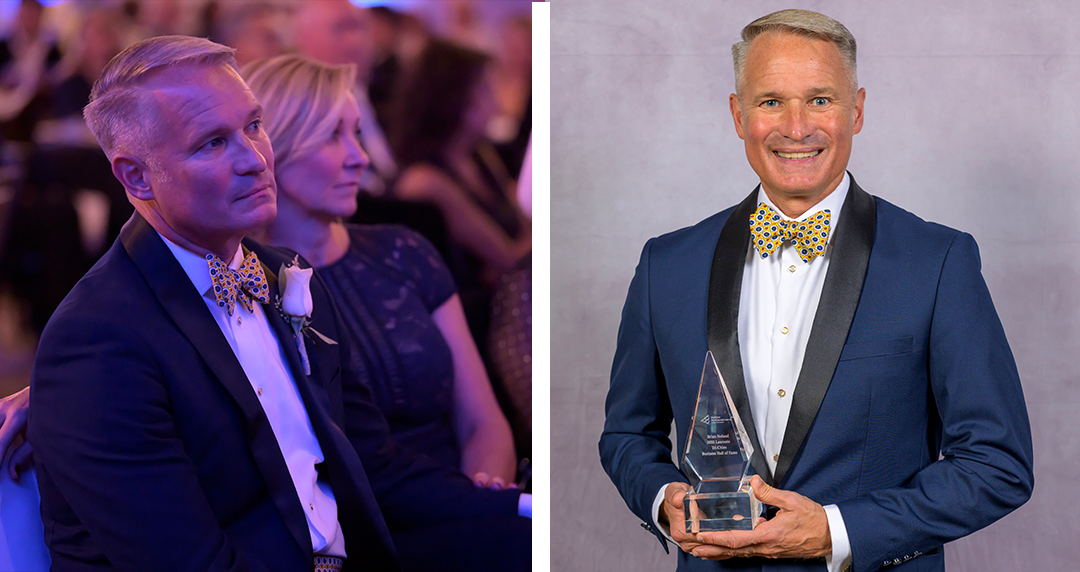
Dr. Brian Noland is the first academician to be inducted into the Tri-Cities Business Hall of Fame. The ETSU president, who’s served in the chief role since 2012, accepted the honor from Junior Achievement of East Tennessee during a mid-November ceremony at the MeadowView Conference Resort and Convention Center in Kingsport.
The ninth president in ETSU history, Noland has led the university to its largest freshman enrollment and highest graduation rates in school history, while also securing record-breaking levels of research funding for the university. On the business and development side, he is a board member for important regional organizations and has overseen several capital projects, including the Martin Center for the Arts.
But it’s his personal story that we’ll explore.
Although raised in Northern Virginia, Noland’s father hails from Western North Carolina, and his wife is a Northeast Tennessee native.
“Even though I did not grow up in the area, all of my family is from the area, and it’s a place I spent a lot of time throughout the entirety of my life,” Noland told the Business Journal in his ETSU office during a December interview.
Noland attended West Virginia University and the University of Tennessee, where he earned a PhD in political science. His original goal was to be a faculty member, but he had the opportunity to work in institutional research, where his passion for numbers and data informed policy making and took him to Nashville, and he worked for the Tennessee Higher Education Commission.
“The highlight of my tenure there was I played a role in developing the lottery scholarship program,” Noland said. “So that legislation passed while I was on staff. I drafted all the financial models, I drafted the original policies, implemented the thing, hired all the staff, and got the lottery scholarship up and moving.”
From there, he moved to West Virginia and served as chancellor of that state’s higher education system. He relocated to Johnson City to lead ETSU nearly 14 years ago.
“I didn’t go to grad school to be a university president; I went to grad school to be a faculty member,” Noland explained. “I wanted to teach American government. I wanted to teach the presidency. My work as a graduate student in early courses that I taught were all American government, American political systems and American political thought. But at a certain point in time, doors opened, and I had an opportunity to pursue some opportunities. But I didn’t go to grad school to become a college president. I went to grad school to be a faculty member.”
He has some individuals who have served as inspirations and role models. Noland names Jim Powell, owner of Powell Construction Company, who also was chair of the Tennessee Higher Education Commission when Noland was on staff.
“I really learned a great deal about this region and service from Jim Powell,” Noland said. “Mr. Powell believed deeply in the power of this university to make a difference in the lives of the blue-collar, hardworking people of this region.”
Noland says more than 4,000 students at ETSU have Powell scholarships. He also counts Carter County Bank founder Bill Greene, philanthropist Scott Niswonger, and ETSU Professor Rich Rhoda as influential mentors.
On campus, the ETSU president says students are what he most enjoys about his job.
“The primary reason that most people go to work in a university setting is to work with students,” Noland said. “I wanted to be a faculty member because a faculty member at West Virginia University instilled a love for American government in me, and I wanted to have the ability to work with students, to get to know them, and watch them grow and evolve.”
The job certainly has challenges, however, when ETSU is the third largest employer in the region, with a $500 million budget, 2,600 employees and more than 14,000 students.
“There’s a lot of moving parts with respect to infrastructure. You run a small town and there’s a lot of complexities associated with that,” he explained. “The pressures on higher education are very different now than they were when I started this job. When I started this job, higher education was seen as a real driving force of change in America, the key to the middle class, and something that a lot of people had faith in as the chance to create a better future for them and for their families. But for a variety of reasons, many people are beginning to question the value of higher education. So, how do we continue to drive home for this region the significant impact that we have on our community? We touch every aspect of Northeast Tennessee, Southwest Virginia and Western North Carolina. One of the great joys and challenges of the job is conveying that impact and reminding people of the powerful impact that we have on Northeast Tennessee.”
Noland has been in the working world for several decades now — and just 11 years shy of the longest-serving ETSU president — but he still has future ambitions.
“There’s a lot of good work left to be done. There are multiple capital projects that are underway. So, I’m hopeful that I have the opportunity to continue to serve the university,” he said. “But at a certain point, I’d like to go teach. That’s the reason I got a PhD, to be in the classroom and to meet with and mentor and to do research. So, at a certain point —- not today, not tomorrow — but when my career comes to a close, I hope it comes to a close in the classroom.”
Outside of work, Noland enjoys time with his wife, Donna, and especially playing basketball. That includes playing basketball on campus with his 21-year-old son and students.
As regionalism flourishes, Noland explains why he’s proud of the Appalachian Highlands.
“This is a region that I still think is one of the best kept secrets in America. It’s doing a better job of telling its story,” he claimed. “But as I look at the region, there are certain things that have occurred during the time period that I’ve had the honor to be here that I’m extremely proud of. A lot of beauty sometimes comes from adversity.”
Noland says the proactive way the region rallied together following the devastation of Hurricane Helene is something people will write books about years from now, specifically about how we came together and overcame adversity.
“You look at the work that you know Jerry (Caldwell) led at the Speedway. That wasn’t led by government; that was led by business. I think everyone in this region should be proud of the way that we continue to work to first recover, and now rebuild, post Helene,” he explained. “I think that the recognition of the importance of the region working together to advance the region as a whole. A decade ago, if you were sitting down and talking to business leaders, they would talk about population decline, about job loss, and they would talk a little bit about — they wouldn’t use the word stagnation — but that was a word that was on a lot of people’s minds. That’s not the case now. This is a region that’s growing and thriving. It’s a region that’s seen people from all across the country move here…That concept of regionalism has begun to take hold…As one entity grows, the whole region grows. It’s not a zero-sum game.”
As for Junior Achievement, where he’s now a Laureate and Hall of Famer, Noland is humbled by the award and proud of the organization.
“When you read down the recipient list, these are legends in the community, and in many respects, I’ve got no business being on this list. It’s still hard to kind of wrap my brain around the fact that I was selected as a recipient,” he said. “In terms of Junior Achievement, we do a lot as a university in conjunction with them — the opportunity to provide service engagement, leadership engagement, community outreach. The work that JA does with young leaders across the region sets the stage for those young leaders to move on and realize their dreams at places like TCAT Elizabethton, East Tennessee State University or the University of Tennessee. I applaud the work of JA and thank them for all that they do to plant seeds in youth all across the region, as they position them to grow on and realize their dreams. Ultimately, for those of us who have an opportunity to work in education or work in public service, all you really do is plant seeds and hope that more than half of those seeds come to bloom.”