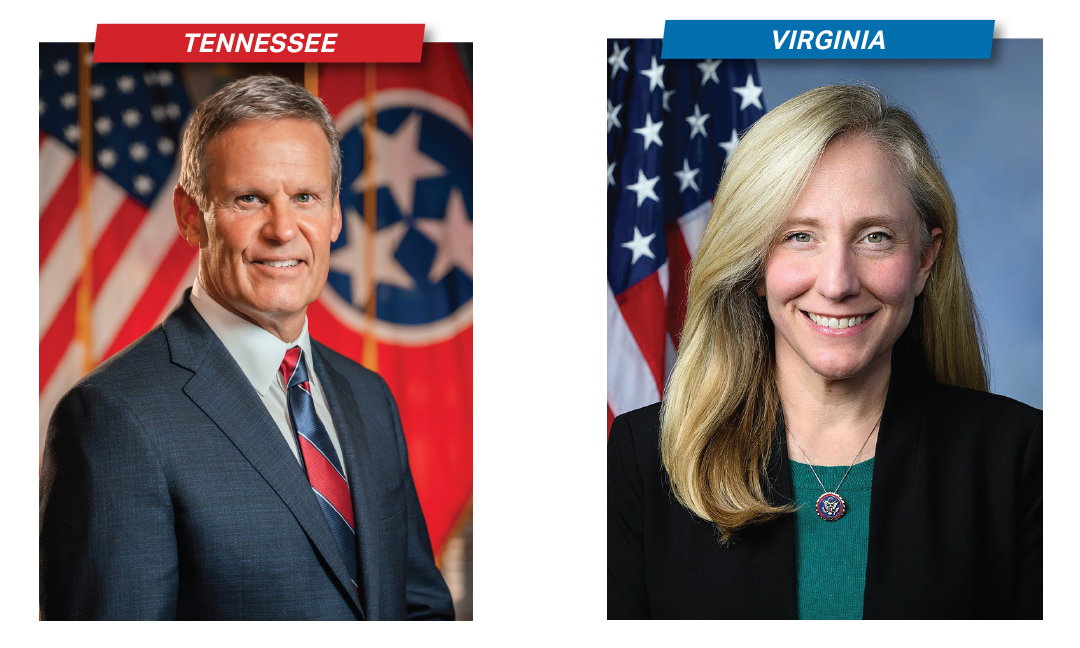
By A.J. Kaufman, Managing Editor
TENNESSEE
The 2026 Tennessee General Assembly convened Jan. 13 and is scheduled to run until mid-April.
For the second half of the 114th General Assembly legislative session, Republicans currently hold a 27-6 Senate majority and control about 75% of House seats. With Gov. Bill Lee in the executive chair for his final year, Tennessee is one of 23 state legislatures where Republicans have the trifecta, a veto-proof supermajority in both houses of the legislature chambers and the governorship.
The ongoing session is expected to be significant, with new laws covering a range of topics, including education, healthcare, housing, public safety and more.
Savanna’s Law is a piece of legislation gaining attention. The law, which creates a registry for repeat domestic violence offenders, is named for Robertson County Sheriff’s Deputy Savanna Puckett, who was murdered in her home in 2022. According to the law, the registry will include the offender’s name, date of birth, conviction day, county and a current photo. The Tennessee Bureau of Investigation will maintain the registry.
Energy, education, crime and healthcare will also be at the forefront of discussions in Nashville. Additionally, Tennessee House Republican leaders are vowing to cut the state’s grocery tax in the future.
Lee has submitted Tennessee’s application for funding through the $50 billion federal Rural Health Transformation Program. The initiative was established under the “One Big Beautiful Bill Act” last summer and is designed to enable states to improve healthcare delivery in rural areas with innovative solutions, while addressing the unique challenges faced by rural healthcare systems.
Tennessee is expected to receive at least $100 million per year for five years, with the potential for additional funding.
Proposed last year and now in effect, HB0749/SB1086 invalidates out-of-state driver licenses issued to illegal immigrants. The bill creates the Class B misdemeanor offense of any form to an out-of-state driver license issued exclusively to people who are in the United States illegally.
Working with the General Assembly last year, the governor also dedicated over $35 million to Tennessee’s Rainy Day Fund, bringing reserves to nearly $2.2 billion, the largest in state history. The fund serves as a crucial fiscal tool to insulate the state’s general fund budget from unexpected revenue reductions or significant unplanned expenditures.
On the education side, with demands for school choice soaring, Lee wants to expand the Education Freedom Act, which passed last year and allowed qualifying families to use state funds for private school scholarships.
He touched on most of these topics during his final State of the State Address on Feb. 2.
Leaders across the Appalachian Highlands are anticipating a busy next few months.
“As usual, we are very interested in the continued or even increase in property development funding. The Site Development Grant (SDG) program has led to a great deal of successes for Sullivan County and Northeast Tennessee, so we are always excited to see that initiative continue,” NETWORKS Sullivan Partnership CEO Clay Walker told the Business Journal. “We’re blessed in Tennessee to be in such a pro-business environment. Our legislators have traditionally made sound decisions in adjusting to the times and changing needs in promoting economic prosperity and I am hopeful and confident that this year’s session will be a continuation of that leadership.”
VIRGINIA
With the conclusion of Gov. Glenn Youngkin’s first tenure in office, the commonwealth’s 164th General Assembly commenced Jan. 14 and adjourns March 16. Democrats hold slim majorities in the Senate and House of Delegates, the oldest continuous English-speaking representative legislative assemblies in the Americas.
As the new lieutenant governor, former State Sen. Ghazala Hashmi is now president of the 40-member senate. Long-time Southwest Virginia Rep. Terry Kilgore remains the House Minority Leader, a key role he’s held since last June.
Toward the end of 2025, former U.S. Rep. Abigail Spanberger, inaugurated as the first female governor of Virginia on Jan. 17, rolled out a comprehensive legislative blueprint she believes will lower costs for Virginia families — from prescription drugs and utility bills to housing — to assist the commonwealth’s economic health.
Spanberger’s “Affordable Virginia Agenda” was announced one day after outgoing Gov. Glenn Youngkin introduced his final biennial budget proposal to the General Assembly. It outlined legislative proposals she hopes will shrink consumer costs across health care, energy and housing. Spanberger has said affordability is “essential” to Virginia’s economic competitiveness — from the Commonwealth’s Eastern Shore to our Appalachian Highlands.
“With a new governor, the business and banking community will be looking hopefully, yet realistically, at proposals, including tax policy and its impact on business competitiveness in the Commonwealth,” Powell Valley National Bank President and CEO Leton Harding told the Business Journal. “The creation of adequate housing stock across the state to ensure employees for the jobs the governor hopes to bring to Virginia needs to be a main focus of the incoming administration and General Assembly. Affordability is certainly part of that, but the biggest challenge is the overall lack of housing stock available, and we need to be creative and flexible in the approaches to expand and accelerate constructing more homes.”
The new governor also believes that stabilizing energy costs is a priority, highlighting what she deems widespread concerns about utility bills in the midst of growing demand, driven partly by data centers and other infrastructure across Virginia. She wants lawmakers to pursue expanded energy storage to help lower peak power prices by allowing stored energy to be used during periods of high demand.
“We’re going to be disagreeing with the governor on some issues, but I think there are more things that we can agree on than disagree,” Kilgore said at a January event in Bristol before the session began. “I look forward to working with the incoming administration and working to ensure that Southwest Virginia’s voices are heard.”
Other 2026 legislative agenda items, especially among more progressive members of the Assembly, include proposals to enshrine abortion rights, modify congressional district outside the 10-year redistricting guidelines, and restore voting rights for convicted felons, while providing monthly “rent relief” to low-income families and implementing significant tax increases on businesses and consumers.
In a nearly-divided government, those partisan pursuits may face uphill challenges from Republicans and perhaps more moderate Democrats. Like any governor, Spanberger will need to tone down the loudest and most radical members of her party to achieve the successes of her predecessor.