By A.J. Kaufman, Managing Editor
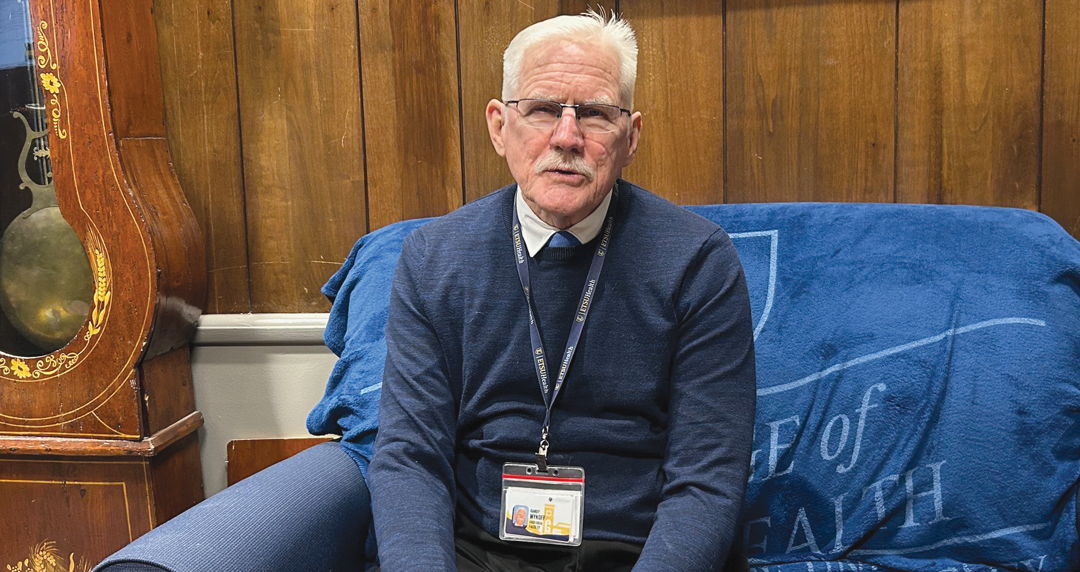
After decades of leadership and service, Dr. Randy Wykoff, founding dean of the ETSU College of Public Health, announced that he will retire at the close of the academic year. Under his guidance, Wykoff transformed ETSU’s College of Public Health into a nationally recognized leader. The college became the first accredited College of Public Health in Tennessee and Central Appalachia, nearly tripled its enrollment since 2006, and established research centers addressing the region’s health challenges. The Business Journal sat down with Wykoff in his ETSU office to learn more about his career.
Business Journal: Tell me about how your career in this field began. Why did you choose ETSU?
Randy Wykoff: I grew up overseas. We lived for four years in Thailand, four years in Uganda and some time in Europe. My dad was career Army, and I come from a long line of medical and public health-type people. I had this idea that I was going to be a doctor and go back to Africa. I came back to the states in high school, I then went to College and Medical School in New Orleans. At the same time, I got a master’s in public health and tropical medicine. I completed residency training in Pediatrics at the University of Virginia and then General Preventive Medicine in Tropical Medicine at Tulane University. In order to pay for medical school, I took a National Health Service Corps scholarship; they paid for med school, and in return, I owed them four years.
They sent me to run six county public health departments in South Carolina. It was an unexpected career twist. When I was in South Carolina, I got involved with AIDS, which was emerging. And then, because of that work, I ended up going to the Food and Drug Administration as their AIDS coordinator. Then I went down to Capitol Hill to work on regulatory reform…then I went back to the FDA as the Associate Commissioner for Operations, followed by serving as the Deputy Assistant Secretary for Health (Disease Prevention and Health Promotion) in the United States Department of Health and Human Services. After that, I went to Project HOPE, which is an international nonprofit, which is sort of my returning to what I thought I would be doing. After three years there, it became clear that I wanted to look for another job, and I saw this job advertised. I’d never been in Tennessee, never been in academia. I applied, and to the university’s credit, they were willing to see that my public health experience was of value to the academic enterprise.
There was something called the College of Public and Allied Health from the 1980s on, and ETSU had an undergraduate degree in health education, but in the early 2000s, they decided that ETSU would become the first School of Public Health in Tennessee. And to do that, we split this old school Public and Allied Health, and I became the first dean of the College of Public Health.
BJ: What are you most proud of during your career?
RW: I am unexpectedly proud of having come to ETSU. I think it’s an institution that is somewhat underappreciated. It’s really quite a remarkable place. There are relatively few universities that are as focused on it, their region, as ETSU is. Obviously, we started as an educational institution to train teachers. Now, we’ve added business, health, all sorts of health programs, arts, and it’s really quite a remarkable institution, and it’s been a great place to do public health because Central Appalachia has some of the worst health statistics in the nation. I’m proud of the team that we’ve got here and proud to be a part of it. I’m not a great believer in legacy, but I’ll have great memories of having been here. I think over the last 20 years, other people have come to discover what a great region this is. We’re seeing lots and lots of people moving here because there’s a great educational system, great healthcare system, good transportation, good quality of life and no state income tax.
BJ: What has been the most challenging aspect as dean over the last two decades?
RW: Challenges are part of the job. I would say one of the most frustrating aspects is that ETSU and the College of Public Health are both much better than most people realize. And it’s frustrating for me every year when the U.S. News rankings come out, and we’re behind schools that, by any rational metric, we’re so much better than they are.
I’ve been really impressed with how many people in this area want to improve health. We’ve got a comprehensive health system. We’ve got all the programs here at ETSU, but we’ve been very lucky to have elected officials in this area who care about health and well-being.
Take the Quillen College of Medicine for a moment. Most med schools are ranked by research productivity and how much money they bring. But what if you did flip it around and said Quillen was created to put primary care docs into rural areas? By those metrics, it’s the best med school in the country. Look at the incredible results coming out of the Gatton School of Pharmacy. Their students have the fifth highest pass rate in the country, and yet the national rankings don’t put them that high.
BJ: As you prepare to depart, tell us your thoughts about where the College of Public Health is as a whole, particularly on the business side.
RW: We’ve grown our enrollment about 7% a year. We’ve gone from 345 students to almost a thousand. We brought in over $50 million in external funding for research. If we were a small business that had grown our customer base and brought in that much external funding, you guys would probably put us on the cover. But people don’t think of it like that. Higher ed is a major business engine, but also, so many jobs are created because of institutions like this. And yet people often don’t think of us that way.
Higher ed is a competitive business. Like any other business, we’re working for market share, customer satisfaction and customer loyalty. We are in the business of delivering excellence in terms of student education, research productivity and service to the community. The vision statement for the College of Public Health is we want to be the school of choice for students who want an exceptional educational experience in a world class environment. And every time I meet with the faculty, we go over that.
We have incredible faculty and staff. I’m always amazed that people will do more than their job description requires of them all the time. And you can’t run a college or a university if people won’t rise to the occasion.
The other thing I’m really proud of is we get some outstanding students. We have some bright kids, and I think it’s a little bit of the characteristic of this region. There are a lot of students who could go anywhere they wanted in the country, but they want to stay near home. It’s always fun for us when, you know, somebody who’s an undergrad here, and then they end up staying and getting their doctoral degree or going to Quillen and getting their medical degree. And that kind of stuff builds the region, too, because then you don’t have a brain drain. You’re keeping the best people here. And now that suddenly everybody is recognizing we’re a great place to live.
BJ: What are your retirement plans, in terms of hobbies and family?
RW: My wife, Janine, and I are very happy here. We’re going to stay here. We have an RV, and we’re going to do a couple more trips, one up to Maine this fall, and then hopefully next summer we’ll do another trip out west. I play the mandolin. I’m going to get back into fly fishing. I haven’t been doing as much of that as I should have. I play pickleball, and I like to stay in shape, so I have some equipment in my house. I do it almost every day.
But I’ll be busy, and I’m working on a book on what we really know about prevention and being healthier. The book focuses on two things: what can you do to prevent disease, and the second, which is a little unusual, is what are the early signs? What to be alert to if something might be going wrong. Because that’s what we call primary and secondary prevention. So that’s what the book is trying to do.
I have five kids. They live in South Dakota, Colorado, Georgia, Kansas City and Chattanooga. I have four grandchildren. When I retire, we’ll go on a family cruise and spend time with them.